
Diplomacy & international affairs · Profile
Mehrojbek Makhmudov
A Return
with a Purpose
After studying the American experience, Mehrojbek Makhmudov looks towards a future return to the United States—with the ambition of serving as Uzbekistan’s ambassador.
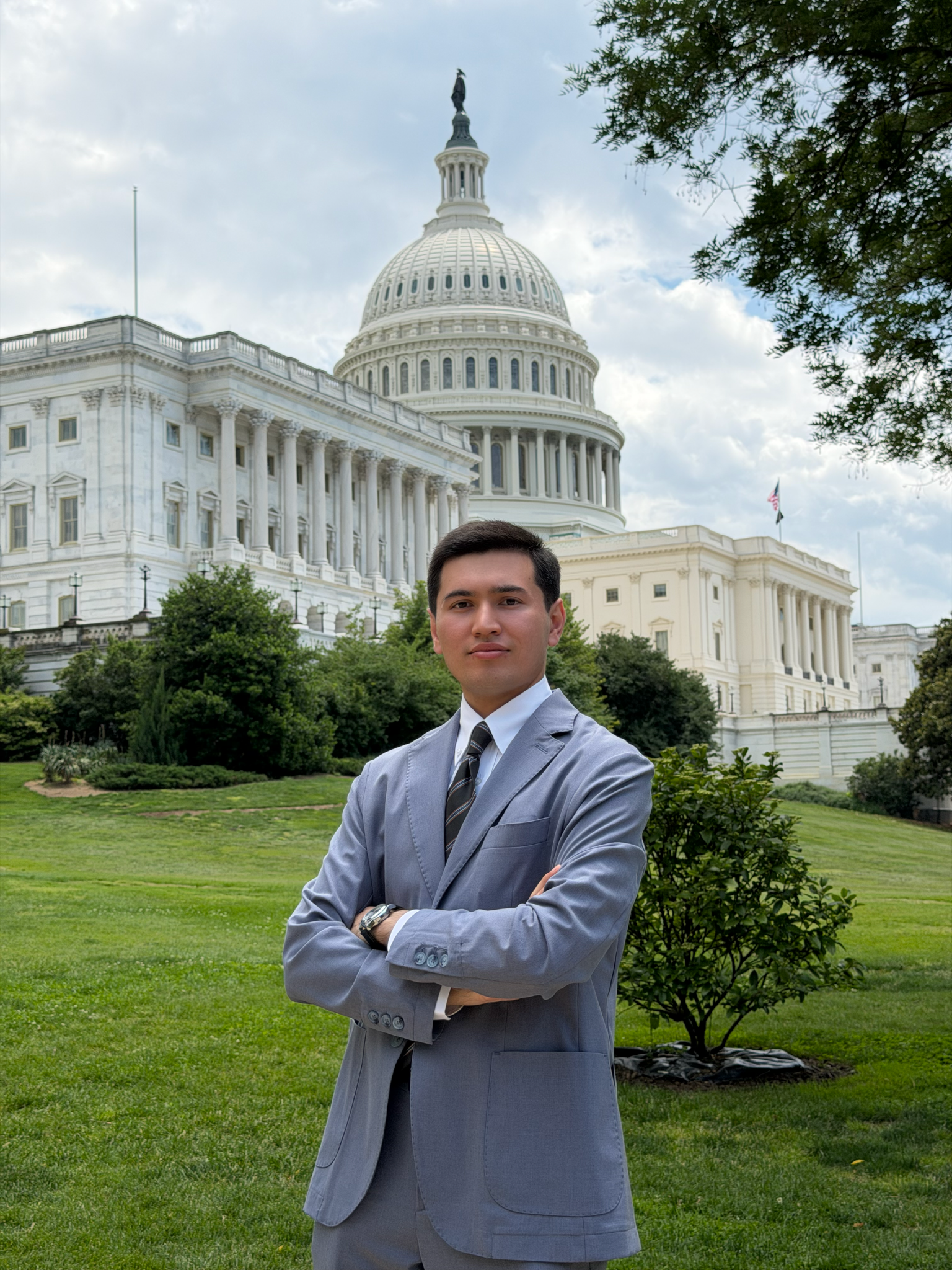
A photograph records where a person has been. An ambition reveals where that person hopes to go. In Mehrojbek Makhmudov’s case, the two are connected by a clear idea: to turn the experience of discovering America into preparation for representing Uzbekistan.
Makhmudov has studied the American experience and looks ahead to returning to the United States in a different capacity. His long-term aspiration is to serve there as Uzbekistan’s ambassador. It is a goal that gives his journey a public dimension: knowledge acquired abroad becomes meaningful through the responsibility it may eventually help a person carry.
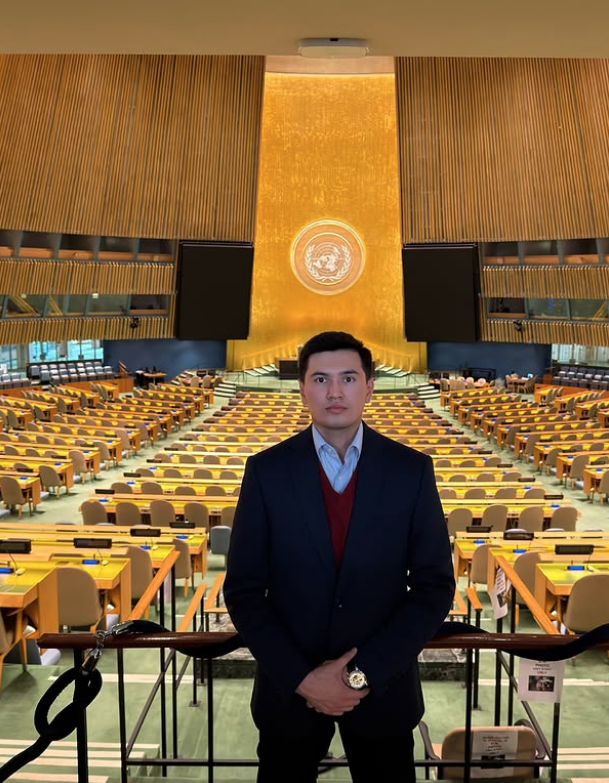
The photographs accompanying this profile place him before the United States Capitol, inside the United Nations General Assembly Hall and beside the New York waterfront. Read together, they provide a visual starting point for a larger question: what does it take to move from observing the international world to representing one’s country within it?
Learning to read a country
For anyone interested in diplomacy, studying another country begins with the discipline of attention. Buildings, ceremonies and public speeches are visible. The relationships between institutions, the language of public debate and the habits through which people cooperate require closer observation.
A comparative approach asks how decisions are made, which institutions shape them and how formal rules interact with everyday practice. It also asks which lessons can travel. An institution that works in one setting may depend on historical experience, professional standards or social expectations that cannot simply be reproduced elsewhere. The value of international exposure lies in learning to recognise those conditions.
This is a useful framework for understanding the significance of Makhmudov’s American experience. A visit can open the door to familiarity; sustained study must turn that familiarity into judgment. For an aspiring representative of Uzbekistan, the essential question is how a deeper understanding of American society could support informed dialogue and practical cooperation between the two countries.
That task calls for intellectual independence. Respect for another country’s achievements should coexist with the ability to examine its difficulties. A future diplomat needs to understand a partner in its complexity, and to explain his own country with the same precision.
The meaning of representation
A country’s voice carries a country’s responsibility.
To represent Uzbekistan is to bring its interests, its people and its perspective into a continuing international conversation. The ambition acquires substance through the preparation behind it.
Learning abroad becomes public value when it improves the quality of service at home.
The work behind the title
The title of “Ambassador” carries considerable prestige, but its deeper significance lies in the responsibilities it entails. Article 3 of the 1961 Vienna Convention on Diplomatic Relations sets out the core functions of a diplomatic mission: representing the sending State, protecting its interests and those of its nationals within the framework of international law, negotiating with the receiving government, lawfully assessing and reporting on developments in the receiving State, and promoting friendly, economic, cultural and scientific relations.
This legal framework provides a meaningful way to understand Makhmudov’s long-term professional aspirations. He does not currently hold the position of ambassador; rather, his interest in diplomacy represents a future professional direction for which he is developing the necessary knowledge, skills and experience. Representation requires a strong understanding of national priorities. Negotiation requires preparation and an ability to understand the perspectives of others. Reporting requires the capacity to distinguish evidence from personal impressions. International cooperation requires patience and the ability to transform an initial conversation into sustainable institutional work.
Language proficiency is important throughout this process. So are the abilities to listen carefully, communicate clearly and recognise the potential consequences of one’s words. Professional credibility develops when knowledge, discretion and sound judgment reinforce one another.
The same seriousness applies to the path toward diplomatic office. Appointment as an ambassador is a matter of official state decision-making, and Article 4 of the Vienna Convention requires the receiving State’s agrément for a proposed head of mission. For Makhmudov, therefore, an ambassadorial role remains a future aspiration rather than a present position. Its significance today lies in the direction it provides for his professional development and in the preparation he undertakes toward a possible future in diplomacy.
Bringing the experience home
International experience reaches beyond the individual when it becomes useful to others. It can inform a discussion, improve a research question or help explain why a particular form of cooperation deserves attention. The challenge is to translate observation into something specific enough to be examined and applied.
For a person preparing for diplomacy, that might mean developing an informed understanding of educational exchange, identifying areas where professional communities could work together, or learning how to present a national position to audiences unfamiliar with its background. These are examples of the practical work through which an ambition can mature.
There is also a discipline of reciprocity. Studying the United States should deepen the ability to understand American perspectives; representing Uzbekistan would require an equally serious ability to communicate Uzbek perspectives. The strongest dialogue allows both sides to become more intelligible to one another.

A future measured in preparation
The next journey begins with the work done now
Ambitious goals have value when they organise effort. For Makhmudov, the prospect of returning to America as Uzbekistan’s ambassador establishes a demanding horizon: deeper knowledge, stronger professional judgment and the ability to earn trust over time.
No photograph can show that entire process. The images capture a presence in places associated with government, international dialogue and the life of a major world city. What follows depends on study, service and the accumulation of experience.
His story therefore invites a forward-looking interpretation. America has been a place to observe and learn. In his vision for the future, it could become a place to serve his country. Between those two possibilities lies the work that gives diplomatic ambition its seriousness.
The hope is to return with a mandate to represent Uzbekistan. The task begins long before that return—with the knowledge, character and responsibility such a mandate would demand.